



Key numbers
- Battery: 65 kWh (2020–2023 Bolt EV/EUV and the 2027 Bolt's LFP pack)
- Home Level 2 (11.5 kW): about 6 h 25 min from empty, 3 h 51 min for 20–80%
- 2027 Bolt DC: 10–80% in 26 min (GM, Oct 2025), 25 min (GM, Apr 2026), 150 kW peak
- 2017–2023 Bolt DC: about 55 kW peak, typically 45–60 min for 10–80%
- Cost to charge 20–80% at 18¢/kWh: about $7.98; full charge about $13.30
On this page
- How to use the Chevy Bolt Charging Time Calculator
- How long does it take to charge a Chevy Bolt?
- How long does the 2027 Chevy Bolt take to fast charge?
- How long does an older Bolt EV or EUV take on a DC fast charger?
- How long does a Bolt take on a regular outlet?
- How much does it cost to charge a Chevy Bolt?
- What is the best home charger for a Chevy Bolt?
- Why is my Bolt charging slowly?
- How long does a Bolt take to recover a typical day of driving?
- How much cheaper is a Bolt to charge than a gas car?
- Charging terms used on this page
- Background: the Bolt’s history
- Frequently asked questions
How to use the Chevy Bolt Charging Time Calculator
- 1Pick the presetsChoose the car. This fills in typical values for you; every field stays editable.
- 2Check or enter your numbersAdjust charger, usable battery size (kWh), charge from (%), charge to (%), car’s max ac charging (kW), car’s max dc charging (kW) and efficiency (mi/kWh).
- 3Check the assumptionsAC time = energy ÷ (lower of charger and car limit, less ~12% losses). DC time assumes the usual taper: about 60% of peak power on average up to 80%, about 25% above 80%. Cold batteries charge slower.
- 4Read the resultsThe calculator shows charging time, energy added to the battery, charging power, range added, range added per hour and full charge 0 → 100%, updated as you type.
Results update as you type. Back to the calculator ↑
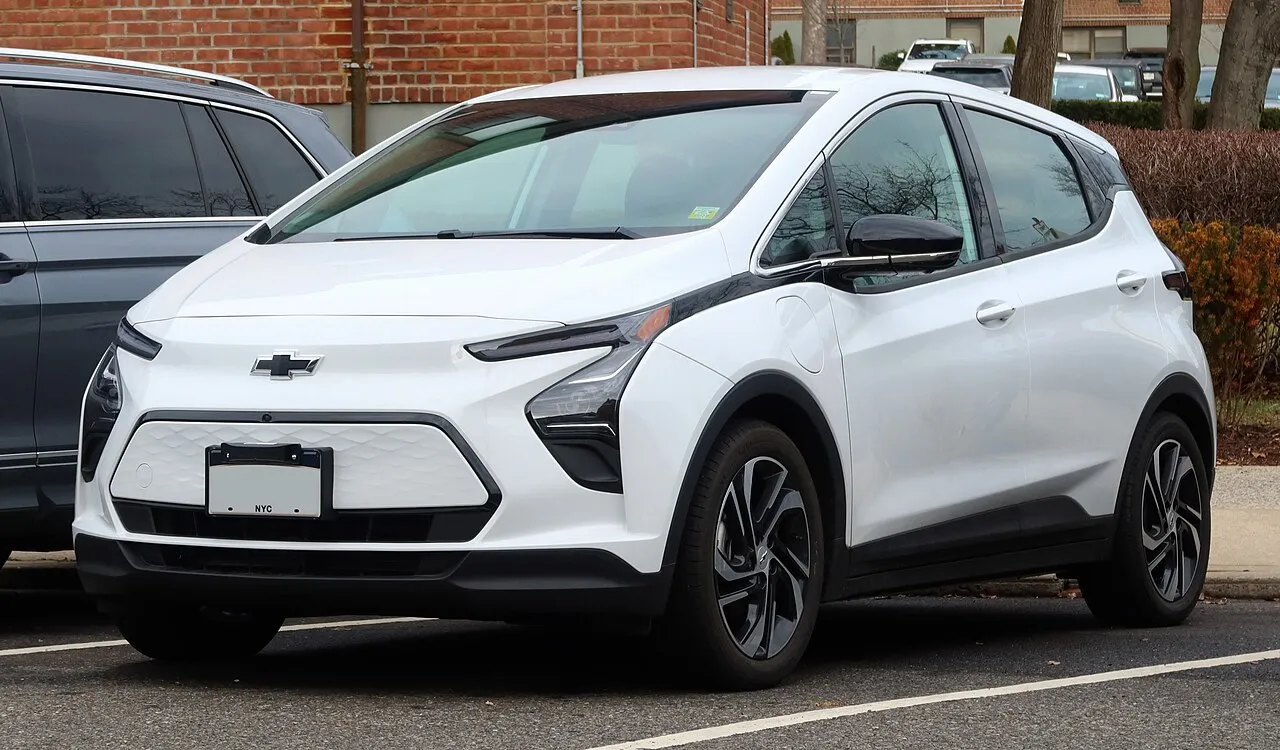
The Chevrolet Bolt has been one of America’s most affordable EVs twice: first as the 2017–2023 Bolt EV and Bolt EUV, and again as the all-new 2027 Bolt. Both carry a 65 kWh battery, so home charging times are similar, but DC fast charging is a different story. The new Bolt charges at up to 150 kW; the original tops out around 55 kW. This page covers both, with real figures for every common charger and what each charge costs.
The calculator above defaults to the 2027 Bolt on an 11.5 kW home charger. Choose the “Chevrolet Bolt EV (2022–23)” preset for an older car, switch the charger, or change the start and end percentages. If you have a 2017–2021 Bolt, set the car’s max AC charging to 7.2 kW. A kWh (kilowatt-hour) measures battery energy; kW (kilowatts) measures charging power.
How long does it take to charge a Chevy Bolt?
Short answer: about 6 h 25 min from empty to full on an 11.5 kW home charger, about 25–26 minutes for 10–80% on DC for the 2027 Bolt, and about 45–60 minutes on DC for a 2017–2023 Bolt.
| Charger | Power at the car | 65 kWh: 20→80% | 65 kWh: 10→100% | 65 kWh: 0→100% | Range added per hour |
|---|---|---|---|---|---|
| Level 1, 120 V outlet | 1.4 kW | 31 h 39 min | 47 h 29 min | 52 h 46 min | about 4–5 mi |
| Level 2, 32 A wallbox | 7.2 kW | 6 h 9 min | 9 h 14 min | 10 h 16 min | about 23–25 mi |
| Level 2, 40 A | 9.6 kW | 4 h 37 min | 6 h 55 min | 7 h 42 min | about 30–33 mi |
| Level 2, 48 A | 11.5 kW (car limit) | 3 h 51 min | 5 h 47 min | 6 h 25 min | about 36–39 mi |
Calculator figures with 12% AC losses. They apply to the 2022–2023 Bolt EV and EUV and the 2027 Bolt, all of which take about 11.5 kW on AC (Recharged’s Bolt EV guide lists 11.5 kW AC and 55 kW DC for 2022–23 cars). Range per hour uses 3.6 miles per kWh of battery energy for the older Bolt and 3.9 for the 2027 car. For 2017–2021 Bolts with a 7.2 kW onboard charger, use the 32 A row for any charger rated 32 A or above.
Worked example
Worked example: 2027 Bolt, 20% to 80% on a 48 A home charger. Energy added = 65 kWh × 60% = 39 kWh. Power into the battery = 11.5 kW × 0.88 = 10.12 kW. Time = 39 ÷ 10.12 = 3.85 hours, about 3 h 51 min. At about 3.9 miles per kWh, those 39 kWh add roughly 152 miles, so even a late plug-in finishes well before morning.
How long does the 2027 Chevy Bolt take to fast charge?
Short answer: GM quotes about 26 minutes for 10–80% (October 2025) and 25 minutes (April 2026) at up to 150 kW; independent results range from roughly that to noticeably slower.
GM’s October 2025 announcement gave the new Bolt a 150 kW peak and about 26 minutes for 10–80%, a big jump from the original Bolt. Its April 2026 update lists 25 minutes. InsideEVs ran its own 10–80% test, while a Canadian winter-season review by DoubleClutch found speeds never exceeded 85 kW, which shows how much battery temperature and the station matter.
The calculator estimates 30 minutes for 10–80% on a 150 kW charger, using a conservative average of 60% of peak power. GM’s 25–26 minute figure implies an average of about 105 kW (45.5 kWh in 26 minutes).
Does the 2027 Bolt charge faster on a 350 kW charger?
Short answer: no. The Bolt’s 150 kW peak is the limit, so a 150 kW, 250 kW or 350 kW station gives about the same session time.
The 2027 Bolt also has a native NACS (SAE J3400) port, so it can plug straight into compatible Tesla Superchargers; for CCS stations it uses an adapter. For non-Tesla Supercharger pricing, see our Tesla Supercharger cost guide.
How long does an older Bolt EV or EUV take on a DC fast charger?
Short answer: about 45–60 minutes for 10–80%, because the 2017–2023 Bolt EV and EUV peak at about 55 kW and slow down above roughly half charge.
| Bolt version | Battery | Onboard AC | Peak DC | Typical DC 10→80% | Charging port |
|---|---|---|---|---|---|
| 2017–2019 Bolt EV | 60 kWh | 7.2 kW | about 55 kW | about 1 hour | CCS1 (DC optional on some) |
| 2020–2021 Bolt EV | 65 kWh | 7.2 kW | about 55 kW | about 1 hour | CCS1 |
| 2022–2023 Bolt EV / EUV | 65 kWh | 11.5 kW | about 55 kW | about 45–60 min | CCS1 |
| 2027 Bolt | 65 kWh LFP | 11.5 kW | 150 kW | 25–26 min (GM) | NACS |
Older-model figures are typical published values; Recharged lists 45–60 minutes for typical 10–80% sessions on 2022–23 cars, and Green Cars Compare gives similar figures for the EUV. The calculator’s DC estimate for the older Bolt (about 1 h 23 min for 10–80%) is deliberately cautious, because the Bolt holds close to its 55 kW peak up to about 50% before tapering, which our generic model does not capture. For trip planning in an older Bolt, charging from about 10% to 60% and moving on is usually the quickest strategy.
How long does a Bolt take on a regular outlet?
Short answer: about 4–5 miles of range per hour on a 120 V outlet, so roughly 32 hours for a 20–80% top-up and 53 hours from empty.
Level 1 charging uses the portable cord supplied with the car in a standard household socket. At about 1.4 kW it suits drivers covering 30–40 miles a day who plug in for 10–12 hours every night. Some Bolt portable cords can also run on 240 V with an adapter, which roughly triples the rate on a suitable outlet; check the cord’s label and your owner’s manual. Our Level 1 vs Level 2 comparison shows where the upgrade pays off.
How much does it cost to charge a Chevy Bolt?
Short answer: about $7.98 for a 20–80% charge and $13.30 for a full charge of the 65 kWh battery at 18¢ per kWh, including charging losses.
| Price per kWh | 20→80% (44.3 kWh from the wall) | Full (73.9 kWh) | Cost per mile, 2027 Bolt | Cost per mile, 2022–23 Bolt |
|---|---|---|---|---|
| 13¢ (off-peak plan) | $5.76 | $9.60 | 3.8¢ | 4.1¢ |
| 18¢ (approx. US average) | $7.98 | $13.30 | 5.2¢ | 5.7¢ |
| 30¢ (high-cost state) | $13.30 | $22.16 | 8.7¢ | 9.5¢ |
| 48¢ (public DC, typical) | $19.91* | n/a | 13.1¢ | 14.2¢ |
*DC rows use 6% losses. 18¢ is close to the national average residential price in the EIA’s Electric Power Monthly. The EPA rates the 2027 Bolt at 28 kWh per 100 miles and 262 miles of range, measured at the wall, one of the most efficient ratings of any current EV. Use your own tariff in the EV charging cost calculator.
What is the best home charger for a Chevy Bolt?
Short answer: a 48 A Level 2 charger on a 60 A circuit gives a 2022–2023 or 2027 Bolt its full 11.5 kW; a 32 A charger is enough for a 2017–2021 Bolt, whose onboard charger takes 7.2 kW.
Buying more than the car can use adds cost without speed. For a 65 kWh Bolt, even a 32 A charger refills a typical 40-mile day in under two hours. The EV charger installation cost calculator estimates breaker, wire and labour costs for 32, 40 and 48 A circuits.
Why is my Bolt charging slowly?
Short answer: a cold battery, a high starting charge, an older Bolt’s 55 kW limit, or a reduced charge-rate setting at home are the usual reasons.
- Cold weather. LFP batteries in the 2027 Bolt in particular charge slowly when cold. Navigating to a DC charger lets the car warm the battery on the way, where supported.
- Charge level. Fast-charge power is highest at low state of charge. Arriving at 10–20% gives the best average.
- Car limits. An older Bolt will not exceed about 55 kW on DC, whatever the charger says.
- Home settings. Check the car’s charge-current setting and the charger’s configured amperage; the portable cord defaults to a lower current on some vehicles.
How long does a Bolt take to recover a typical day of driving?
Short answer: a 40-mile day takes about 2 hours to replace on a 32 A charger, about 1 hour on a 48 A charger, and about 9 hours on a 120 V outlet.
Most owners never charge from empty. What matters is how long it takes to put back what you used today. The table uses 3.6 miles per kWh of battery energy for a 2022–2023 Bolt and 3.9 for the 2027 car, and includes 12% charging losses.
| Daily miles | 120 V outlet (1.4 kW) | 32 A wallbox (7.2 kW) | 48 A wallbox (11.5 kW) | Energy from the wall (2022–23 / 2027) |
|---|---|---|---|---|
| 20 mi | about 4.5 h / 4.2 h | about 53 / 49 min | about 33 / 30 min | 6.3 / 5.8 kWh |
| 40 mi | about 9.0 h / 8.3 h | about 1 h 45 min / 1 h 37 min | about 1 h 6 min / 1 h 1 min | 12.6 / 11.7 kWh |
| 80 mi | about 18.0 h / 16.7 h | about 3 h 30 min / 3 h 14 min | about 2 h 12 min / 2 h 2 min | 25.3 / 23.3 kWh |
This is why many Bolt owners manage on a 120 V outlet: 20–40 miles a day fits into a normal night. Above about 50 miles a day, or with a household that shares one car, Level 2 is worth the installation cost. Cold weather increases energy use, often by 20–30% in freezing conditions when the cabin heater runs, so winter recovery times on Level 1 can stretch past a single night.
How much cheaper is a Bolt to charge than a gas car?
Short answer: at 18¢ per kWh a 2027 Bolt costs about 5.2¢ per mile, against about 14.3¢ per mile for a 30 mpg gas car at $4.28 a gallon, a saving of roughly $1,080 a year over 12,000 miles.
| Vehicle and energy | Price | Cost per mile | 12,000 miles a year |
|---|---|---|---|
| 2027 Bolt, home charging | 18¢ per kWh | 5.2¢ | about $629 |
| 2022–23 Bolt, home charging | 18¢ per kWh | 5.7¢ | about $682 |
| 2027 Bolt, public DC | 48¢ per kWh | 13.1¢ | about $1,571 |
| Gas compact car, 30 mpg | $4.28 per gallon | 14.3¢ | about $1,712 |
$4.28 is this site’s US planning default for regular gasoline; current averages are in the EIA’s weekly gasoline price survey. Home charging is where the savings come from: a Bolt charged mostly at public DC stations costs nearly as much per mile as an efficient gas car. To include purchase price, incentives and maintenance, use the EV vs gas calculator.
Charging terms used on this page
Short answer: kW is charging speed, kWh is energy, and the charger level tells you which kind of plug and power you are using.
- kWh (kilowatt-hour): a unit of energy; battery size and your electricity bill are both measured in kWh.
- kW (kilowatt): a unit of power; a 10 kW charger adds about 10 kWh per hour before losses.
- Level 1: charging from a 120 V household outlet, about 1.4 kW.
- Level 2: 208–240 V AC charging at home or in public, usually 7–19 kW.
- DC fast charging: high-power direct current fed straight to the battery, 50–350 kW at the station.
- State of charge (SoC): how full the battery is, as a percentage.
- NACS (SAE J3400): the Tesla-designed connector now adopted across North America; for the Chevy Bolt, the 2027 Bolt ships with a NACS port while older Bolts use CCS1.
Background: the Bolt’s history
Chevrolet launched the Bolt EV for the 2017 model year as the first affordable long-range EV in the US, with about 238 miles of EPA range from a 60 kWh pack, beating the Tesla Model 3 to customers. The pack grew to 65 kWh in 2020, and the 2022 refresh added the larger Bolt EUV and an 11.5 kW onboard charger. Production ended in December 2023, after GM had carried out a large battery recall on earlier cars. GM revived the name with the 2027 Bolt, a new car with a 65 kWh lithium iron phosphate pack, 150 kW DC charging and a NACS port; Drive Tesla Canada reported a US starting price of about $29,000. For battery costs on other models, see the Nissan Leaf battery replacement cost page; for other cars, the EV charging time calculator. Assumptions are on our methodology page. Chevrolet and Bolt are trademarks of General Motors; EV Cost Guide is not affiliated with GM.
FAQ
Frequently asked questions
How long does a Chevy Bolt take to charge at home?
On an 11.5 kW (48 A) Level 2 charger, a 65 kWh Bolt goes from empty to full in about 6 h 25 min and from 20% to 80% in about 3 h 51 min, including 12% losses. That applies to the 2022–2023 Bolt EV and EUV and the 2027 Bolt. A 2017–2021 Bolt with a 7.2 kW onboard charger takes about 10 h 16 min for a full charge.
How long does the 2027 Chevy Bolt take to fast charge?
GM announced 10–80% in about 26 minutes at a peak of 150 kW in October 2025 and listed 25 minutes in an April 2026 update. Independent tests vary: one Canadian road test never saw more than 85 kW. Expect 25–35 minutes on a good 150 kW or faster charger with a warm battery.
How long does an older Chevy Bolt take on a DC fast charger?
The 2017–2023 Bolt EV and Bolt EUV peak at about 55 kW, and typical 10–80% sessions take about 45–60 minutes. Plugging into a 150 kW or 350 kW charger does not help, because the car limits the power. Charging slows sharply above about 50–60%.
How long does a Chevy Bolt take to charge on a regular outlet?
A 120 V outlet supplies about 1.4 kW, which adds about 4–5 miles of range per hour. A full charge of a 65 kWh Bolt takes about 53 hours and a 20–80% top-up about 32 hours. It works for short commutes if you plug in nightly, but a 240 V outlet or Level 2 charger is much more practical.
How much does it cost to charge a Chevy Bolt?
At about 18¢ per kWh, a full charge of a 65 kWh Bolt costs about $13.30 and a 20–80% top-up about $7.98, including 12% charging losses. The 2027 Bolt works out to about 5.2¢ per mile at that rate. On a public DC charger at around 48¢ per kWh, a 20–80% session costs about $19.91.
Can the Chevy Bolt use Tesla Superchargers?
The 2027 Bolt has a native NACS (SAE J3400) port and can use compatible Tesla Superchargers directly. Older Bolt EVs and EUVs have a CCS1 port and need a GM-approved NACS adapter. On older Bolts, the car's 55 kW peak still limits speed, so Supercharger sessions remain long.
Should I charge my Chevy Bolt to 100%?
The 2027 Bolt uses LFP cells, which tolerate regular full charges well. For 2017–2023 Bolts, which use nickel-based cells, many owners set a target charge level around 80–90% for daily use and charge to 100% before long trips. Follow GM's current guidance for your vehicle.
9 Sources
- GM News: Everything new to love on the 2027 Chevy Bolt (16 Oct 2025): 150 kW, 10–80% about 26 min, NACS
- GM News: 2027 Chevrolet Bolt update (22 Apr 2026): 10–80% in 25 min, pricing
- fueleconomy.gov: 2027 Chevrolet Bolt EPA rating, 28 kWh/100 mi, 262 mi
- InsideEVs: 2027 Chevy Bolt EV charging test, 10–80%
- DoubleClutch: Review, 2027 Chevrolet Bolt (charging test, peak under 85 kW)
- Drive Tesla Canada: 2027 Chevrolet Bolt pricing and 65 kWh LFP battery
- Recharged: How long to charge a Chevrolet Bolt EV (2022–23: 11.5 kW AC, 55 kW DC)
- Green Cars Compare: Chevrolet Bolt EUV Gen 1 charging
- US EIA: Electric Power Monthly, average residential price by state
Last reviewed October 25, 2026 by Izhar Ahmad Danish. EV specs and prices change: check your car’s manual and your tariff. Found an error? Tell us.