



Key numbers
- Batteries (2025+ US): 63 kWh Standard Range and 84 kWh Long Range
- DC fast 10–80%: about 18 minutes on 350 kW, peak about 258 kW (reported)
- Home Level 2 (10.9 kW onboard): about 8 h 45 min from empty (84 kWh)
- EPA range: 319 mi Long Range RWD, 270–295 mi AWD, 231 mi GT
- Cost to charge 20–80% at 18¢/kWh: about $10.31 (84 kWh), $7.73 (63 kWh)
On this page
- How to use the Kia EV6 Charging Time Calculator
- How long does it take to charge a Kia EV6?
- How fast does the EV6 charge on a DC fast charger?
- How long does an EV6 take to charge at home on Level 2?
- How much does it cost to charge a Kia EV6?
- Which EV6 version charges fastest?
- Why is my EV6 charging slower than advertised?
- How does EV6 charging compare with similar EVs?
- How long does an EV6 road-trip charging stop take?
- Charging terms used on this page
- Background: the EV6 and the E-GMP platform
- Frequently asked questions
How to use the Kia EV6 Charging Time Calculator
- 1Pick the presetsChoose the car. This fills in typical values for you; every field stays editable.
- 2Check or enter your numbersAdjust charger, usable battery size (kWh), charge from (%), charge to (%), car’s max ac charging (kW), car’s max dc charging (kW) and efficiency (mi/kWh).
- 3Check the assumptionsAC time = energy ÷ (lower of charger and car limit, less ~12% losses). DC time assumes the usual taper: about 60% of peak power on average up to 80%, about 25% above 80%. Cold batteries charge slower.
- 4Read the resultsThe calculator shows charging time, energy added to the battery, charging power, range added, range added per hour and full charge 0 → 100%, updated as you type.
Results update as you type. Back to the calculator ↑
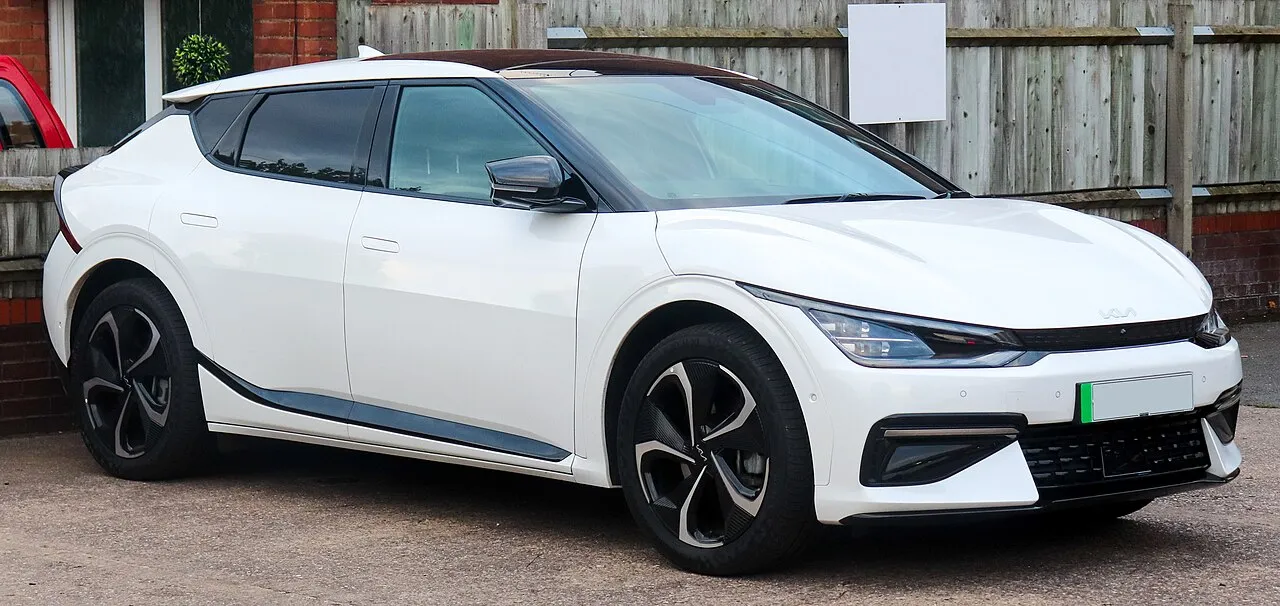
The Kia EV6 is one of the fastest-charging cars at its price, thanks to an 800-volt battery shared with the Hyundai Ioniq 5. How long it takes in practice ranges from under 20 minutes to almost three days, depending on the charger. This page gives realistic times for every common charger, explains where the official figures come from and shows what a charge costs.
The calculator above defaults to the 2025+ 84 kWh EV6 on an 11.5 kW home charger. Change the charger to a DC unit to see fast-charging times, pick the older 77.4 kWh preset for a 2022–2024 car, or type your own battery size. A kWh (kilowatt-hour) is a unit of battery energy; kW (kilowatts) is charging power.
How long does it take to charge a Kia EV6?
Short answer: about 18–20 minutes for 10–80% on a 350 kW DC charger, about 8 h 45 min from empty on an 11 kW home charger, and about 68 hours on a 120 V outlet (84 kWh battery).
| Charger | Power at the car | 84 kWh: 20→80% | 84 kWh: 0→100% | 63 kWh: 20→80% | 63 kWh: 0→100% |
|---|---|---|---|---|---|
| Level 1, 120 V outlet | 1.4 kW | 40 h 55 min | 68 h 11 min | 30 h 41 min | 51 h 8 min |
| Level 2, 32 A wallbox | 7.2 kW | 7 h 57 min | 13 h 15 min | 5 h 58 min | 9 h 57 min |
| Level 2, 40 A | 9.6 kW | 5 h 58 min | 9 h 57 min | 4 h 28 min | 7 h 28 min |
| Level 2, 48 A | 10.9 kW (car limit) | 5 h 15 min | 8 h 45 min | 3 h 56 min | 6 h 34 min |
| DC fast, 50 kW | 50 kW | 1 h 41 min | n/a | 1 h 16 min | n/a |
| DC fast, 150 kW | 150 kW | 34 min | n/a | 25 min | n/a |
| DC ultra-fast, 350 kW | up to ~258 kW | 20 min | n/a | 15 min (est.) | n/a |
Calculator figures: AC times include 12% losses; DC times assume average power of 60% of peak up to 80%, which is conservative for E-GMP cars. The 63 kWh DC row uses the same peak as an estimate because Kia’s battery-specific curves are not published in the US. InsideEVs’ review of the 2025 US spec covers the move to the 84 kWh battery and NACS port, and Automoblog’s overview gives the 18-minute 10–80% claim.
Worked example
Worked example: 84 kWh EV6, 20% to 80% on a 40 A home charger. Energy added = 84 kWh × 60% = 50.4 kWh. Power into the battery = 9.6 kW × 0.88 = 8.45 kW. Time = 50.4 ÷ 8.45 = 5.97 hours, about 5 h 58 min. At about 3.4 miles per kWh that adds roughly 171 miles, enough for most weeks of commuting from one overnight session.
How fast does the EV6 charge on a DC fast charger?
Short answer: about 18 minutes for 10–80% on a 350 kW charger in good conditions, with a reported peak around 258 kW; expect 30–40 minutes on a 150 kW unit.
DC fast charging bypasses the car’s onboard charger and feeds the battery directly. Sources differ slightly on peak power: some coverage cites a peak of 258 kW, while others say the car accepts approximately 250 kW. Either way, what makes the EV6 quick is that it holds high power for most of the session. Guide Auto’s 2025 review and WardsAuto both describe the update as keeping charging times about the same while adding capacity, so the car now adds more miles in the same time.
Does the EV6 charge slower at a Tesla Supercharger?
Short answer: yes. Superchargers run at about 400 volts, and the EV6’s 800-volt battery has to boost the voltage, so sessions take several minutes longer than at a 350 kW CCS station.
US 2025 EV6 models other than the GT have a native NACS (SAE J3400) port, and older cars can use an adapter. Hyundai quotes about 30 minutes for 10–80% on a Supercharger for the closely related 84 kWh Ioniq 5 (see our Ioniq 5 charging time page); expect similar for the EV6. Superchargers are still useful because there are so many of them, but if a working 350 kW CCS station is nearby it is usually faster.
How long does an EV6 take to charge at home on Level 2?
Short answer: about 8 h 45 min from empty for the 84 kWh battery and about 6 h 34 min for the 63 kWh battery on a 48 A charger; about 13 and 10 hours on a 32 A wallbox.
Level 2 is 208–240 V AC charging. The Department of Energy’s Alternative Fuels Data Center explains that Level 2 adds roughly 10–30+ miles of range per hour depending on the car and charger. The EV6’s onboard charger accepts about 10.9 kW, so a 48 A charger on a 60 A circuit gives the full rate. A 40 A charger is only about 12% slower, and the difference rarely matters for overnight charging.
| Home setup | Breaker | Miles added per hour (84 kWh) | Range added in 8 hours overnight |
|---|---|---|---|
| 120 V outlet, 1.4 kW | 15–20 A | about 4 mi | about 34 mi |
| 32 A wallbox, 7.2 kW | 40 A | about 22 mi | about 172 mi |
| 40 A wallbox, 9.6 kW | 50 A | about 29 mi | about 230 mi |
| 48 A wallbox, 11.5 kW | 60 A | about 33 mi | about 261 mi |
Miles per hour = power into the battery × 3.4 miles per kWh. For installation pricing, see the EV charger installation cost calculator, and for when Level 1 is enough, the Level 1 vs Level 2 guide.
How much does it cost to charge a Kia EV6?
Short answer: about $10.31 for a 20–80% charge and $17.18 for a full charge of the 84 kWh battery at 18¢ per kWh, including charging losses.
| Price per kWh | 63 kWh: 20→80% | 63 kWh: full | 84 kWh: 20→80% | 84 kWh: full | Cost per mile (84 kWh) |
|---|---|---|---|---|---|
| 13¢ (off-peak plan) | $5.58 | $9.31 | $7.45 | $12.41 | 4.3¢ |
| 18¢ (approx. US average) | $7.73 | $12.89 | $10.31 | $17.18 | 6.0¢ |
| 30¢ (high-cost state) | $12.89 | $21.48 | $17.18 | $28.64 | 10.0¢ |
| 48¢ (public DC, typical) | $19.30* | n/a | $25.74* | n/a | 15.0¢* |
*DC rows use 6% losses. 18¢ is close to the national average residential price in the EIA’s Electric Power Monthly. Cost per mile uses 3.4 miles per kWh of battery energy; the EPA rates the Long Range RWD at 30 kWh per 100 miles at the wall, so efficient drivers will beat these figures. Use the miles per kWh calculator to work out your own.
Which EV6 version charges fastest?
Short answer: all 2025+ versions take roughly 18–20 minutes for 10–80% on a 350 kW charger, but the Long Range RWD adds the most miles per minute because it is the most efficient.
| Version (2025–26) | Battery | EPA kWh/100 mi | EPA range | Approx. miles added in 18 min (10→80%) |
|---|---|---|---|---|
| Standard Range RWD | 63 kWh | 29 | 237 mi | about 166 mi |
| Long Range RWD | 84 kWh | 30 | 319 mi | about 223 mi |
| Long Range AWD, 19-inch wheels | 84 kWh | 32 | 295 mi | about 207 mi |
| Long Range AWD, 20-inch wheels | 84 kWh | 35 | 270 mi | about 189 mi |
| GT AWD | 84 kWh | 40–41 | 231 mi | about 162 mi |
EPA figures from fueleconomy.gov. Miles added = 70% of EPA range, a simple approximation; highway driving, cold weather and bigger wheels reduce it.
Why is my EV6 charging slower than advertised?
Short answer: battery temperature, station voltage and sharing, and your starting state of charge explain most slow sessions.
- Precondition the battery. Set a DC charger as the navigation destination so the car warms the battery on the way. A cold battery can double the session.
- Pick an 800-volt, unshared stall. 350 kW CCS stations at full output give the advertised times; 400-volt units and shared cabinets do not.
- Arrive low, leave at 80%. Power is highest from about 10% to 50% and falls sharply above 80%.
- Check the car’s charge limit. A DC limit set to 80% stops the session early; the AC current setting can also reduce home charging speed.
How does EV6 charging compare with similar EVs?
Short answer: the EV6 is among the quickest in its class on a 350 kW charger, roughly level with the Ioniq 5 and well ahead of 150 kW-limited rivals such as the Mustang Mach-E, which need about 35 minutes for 10–80%.
| Model (US, recent) | Battery (approx. usable or quoted) | Peak DC | 10→80% best case | Home 0→100% at 48 A |
|---|---|---|---|---|
| Kia EV6 Long Range | 84 kWh | about 250–258 kW | about 18–20 min | about 8 h 45 min |
| Hyundai Ioniq 5 Long Range | 84 kWh | about 260 kW (tested) | about 18–20 min | about 8 h 45 min |
| Ford Mustang Mach-E Extended Range | 91 kWh | about 150 kW | about 35–45 min | about 9 h 24 min |
| Chevrolet Bolt (2027) | 65 kWh | 150 kW | 25–26 min (GM) | about 6 h 25 min |
Figures come from this site’s model pages: Ioniq 5, Mustang Mach-E and Chevy Bolt, each with its own sources. The EV6 and Ioniq 5 share the same battery and electronics, so their charging behaviour is nearly identical; the EV6 Long Range RWD’s EPA rating of 319 miles is one mile more than the Ioniq 5 RWD’s 318 miles.
The comparison shows why the battery’s voltage matters. An 800-volt car like the EV6 draws high power at lower current, so it can sustain 200+ kW without overheating cables and cells. A 400-volt car with a similar battery usually peaks lower or tapers sooner. On 150 kW chargers, though, the gap narrows sharply, because the charger rather than the car becomes the limit.
How long does an EV6 road-trip charging stop take?
Short answer: about 18–25 minutes per stop on a 350 kW charger if you arrive near 10% and leave at about 80%, which adds roughly 200 miles of highway driving in a Long Range RWD.
From 10% to 80% the 84 kWh battery takes in about 59 kWh. At a typical highway efficiency of about 3.0–3.4 miles per kWh, that is 175–200 miles before the next stop. Charging beyond 80% rarely pays: on DC the last 20% takes about as long as the first 70%, so two short stops are usually faster than one long one. Plan for more stops in winter, when cabin heating and cold cells cut range and charging speed. In the UK, EV Powered reported that the updated EV6 also brought faster charging there, with WLTP range figures that run well above US EPA numbers because the test cycles differ.
How long does it take to charge an EV6 from 0 to 100%?
Short answer: about 8 h 45 min at home on a 48 A charger for the 84 kWh battery; on DC fast charging, a full 0–100% session takes roughly 40–50 minutes because the last 20% is slow.
Most drivers never need a full DC charge. If you are about to start a long trip, the cheapest and gentlest option is to charge to 100% at home overnight just before you leave, then use fast chargers between 10% and 80% along the way.
Charging terms used on this page
Short answer: kW is charging speed, kWh is energy, and the charger level tells you which kind of plug and power you are using.
- kWh (kilowatt-hour): a unit of energy; battery size and your electricity bill are both measured in kWh.
- kW (kilowatt): a unit of power; a 10 kW charger adds about 10 kWh per hour before losses.
- Level 1: charging from a 120 V household outlet, about 1.4 kW.
- Level 2: 208–240 V AC charging at home or in public, usually 7–19 kW.
- DC fast charging: high-power direct current fed straight to the battery, 50–350 kW at the station.
- State of charge (SoC): how full the battery is, as a percentage.
- NACS (SAE J3400): the Tesla-designed connector now adopted across North America; for the Kia EV6, an 800-volt car like the EV6 needs boosting at 400-volt stations.
Background: the EV6 and the E-GMP platform
Kia revealed the EV6 in March 2021 as its first car on the Hyundai Motor Group’s Electric-Global Modular Platform, the same 800-volt architecture used by the Hyundai Ioniq 5 and Genesis GV60. Its 800-volt system lets it accept high charging power at lower current, which limits heat and keeps the charging curve flat. The car went on to win the 2022 European Car of the Year. The 2025 update, built in Georgia for the US market, brought the 84 kWh battery and a NACS port on most trims. For sister models, see the Ioniq 5 page; for other cars, the EV charging time calculator. Assumptions are explained on our methodology page. Kia and EV6 are trademarks of Kia Corporation; EV Cost Guide is not affiliated with Kia.
FAQ
Frequently asked questions
How long does a Kia EV6 take to charge on a DC fast charger?
About 18 minutes for 10–80% on a 350 kW charger for the 2025 EV6 with the 84 kWh battery, according to launch coverage, with most sources putting it under 20 minutes in good conditions. On a 150 kW charger it takes roughly 30–40 minutes, and on a 50 kW charger well over an hour, because the station rather than the car becomes the limit.
How long does a Kia EV6 take to charge at home?
On a Level 2 charger that matches the car's 10.9 kW onboard charger, an 84 kWh EV6 goes from empty to full in about 8 h 45 min and from 20% to 80% in about 5 h 15 min, including 12% losses. On a common 7.2 kW wallbox a full charge takes about 13 hours.
How long does it take to charge a Kia EV6 on a regular outlet?
A 120 V outlet supplies about 1.4 kW, which adds about 4 miles of range per hour. A full charge of the 84 kWh battery would take about 68 hours and a 20–80% top-up about 41 hours. It works for short daily commutes if the car is plugged in every night, but most owners install Level 2.
How much does it cost to charge a Kia EV6?
At about 18¢ per kWh, a 20–80% charge of the 84 kWh EV6 costs about $10.31 at home and a full charge about $17.18, including 12% losses. The 63 kWh model costs about $7.73 and $12.89. A 20–80% session on a public DC charger at 48¢ per kWh costs about $25.74.
Can a Kia EV6 use Tesla Superchargers?
Yes. US 2025 EV6 models other than the GT have a native NACS port and can use compatible Superchargers; earlier models and the GT use a CCS1 port and an adapter. Like other 800-volt cars, the EV6 charges more slowly on 400-volt Superchargers than on 350 kW CCS stations.
What is the Kia EV6 max charging speed?
Coverage of the 2025 update cites a peak of about 258 kW for the 84 kWh battery, with some sources saying it accepts approximately 250 kW. The important figure is the average across 10–80%, which is roughly 165–195 kW on a 350 kW charger, giving the 18–20 minute session.
Is the EV6 GT slower to charge?
On DC the EV6 GT uses the same 800-volt platform and charges in a similar 18–20 minutes for 10–80%. Its range is lower, at 231 miles EPA, so it adds fewer miles per minute. In the US the 2025 GT kept the CCS1 port rather than switching to NACS.
8 Sources
- fueleconomy.gov: 2025–2026 Kia EV6 EPA ratings
- InsideEVs: 2025 Kia EV6 made in America with NACS plug, bigger battery
- Automoblog: 2025 Kia EV6 overview, fast-charging times
- Guide Auto: 2025 Kia EV6 review
- WardsAuto: Kia EV6 upgrades keep pace with newer BEVs
- EV Powered: updated Kia EV6 brings faster charging (UK)
- US EIA: Electric Power Monthly, average residential price by state
- US DOE Alternative Fuels Data Center: charging levels
Last reviewed October 25, 2026 by Izhar Ahmad Danish. EV specs and prices change: check your car’s manual and your tariff. Found an error? Tell us.