



Key numbers
- Usable battery: 98 kWh (Standard Range) and 131 kWh (Extended Range)
- DC fast 15–80% (Ford, 2025): about 32 min Standard, 38 min Extended Range
- Onboard charger: 80 A / 19.2 kW on 2022–23 Extended Range; 48 A / about 11.5 kW on all 2024–25 trucks
- Home 48 A, 0–100%: about 9 h 51 min (98 kWh) and 12 h 57 min (131 kWh)
- Cost to charge 20–80% at 18¢/kWh: about $12.03 (98 kWh) and $16.08 (131 kWh)
On this page
- How to use the F-150 Lightning Charging Time Calculator
- How long does it take to charge an F-150 Lightning?
- How long does a Lightning take on a DC fast charger?
- How long does a Lightning take to charge at home?
- How long does a Lightning take on a regular outlet?
- How much does it cost to charge an F-150 Lightning?
- Why does a Lightning charge slower than expected?
- How many charging stops does a Lightning need when towing?
- Is charging a Lightning cheaper than fuelling a gas F-150?
- Charging terms used on this page
- Background: the Lightning’s short history as a full EV
- Frequently asked questions
How to use the F-150 Lightning Charging Time Calculator
- 1Pick the presetsChoose the car. This fills in typical values for you; every field stays editable.
- 2Check or enter your numbersAdjust charger, usable battery size (kWh), charge from (%), charge to (%), car’s max ac charging (kW), car’s max dc charging (kW) and efficiency (mi/kWh).
- 3Check the assumptionsAC time = energy ÷ (lower of charger and car limit, less ~12% losses). DC time assumes the usual taper: about 60% of peak power on average up to 80%, about 25% above 80%. Cold batteries charge slower.
- 4Read the resultsThe calculator shows charging time, energy added to the battery, charging power, range added, range added per hour and full charge 0 → 100%, updated as you type.
Results update as you type. Back to the calculator ↑
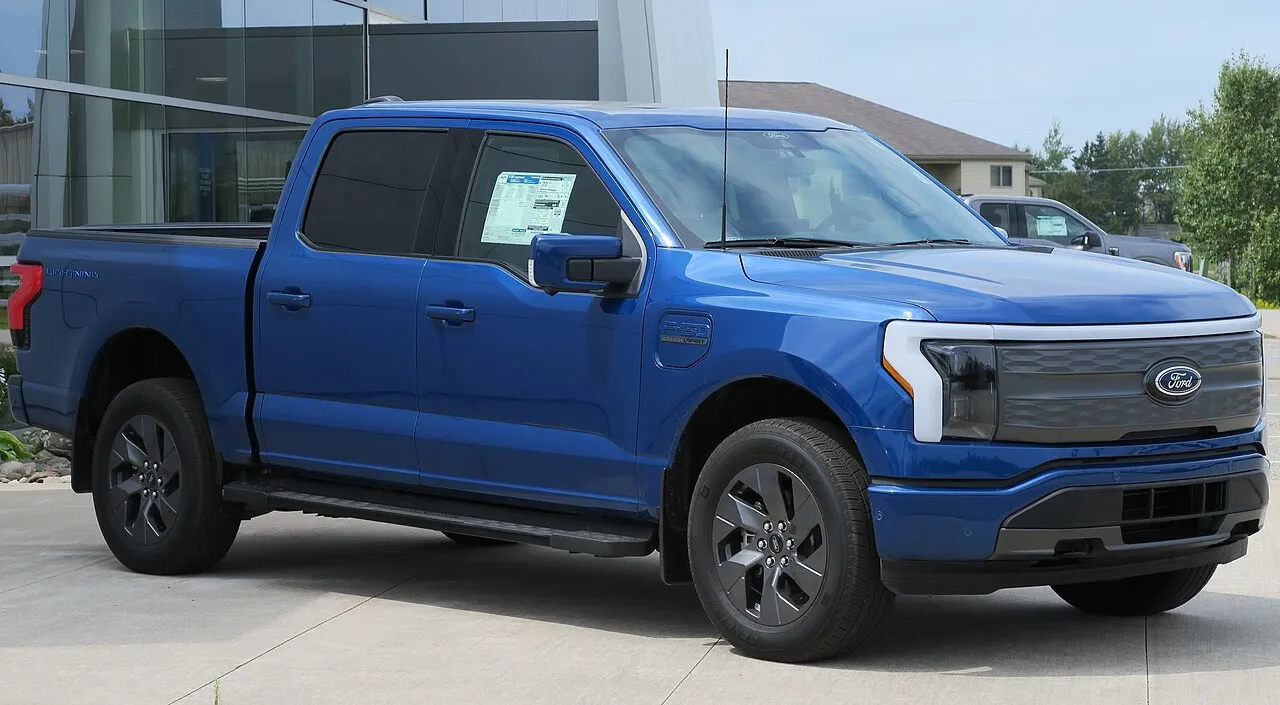
The Ford F-150 Lightning carries a 98 kWh or 131 kWh battery, two to three times the size of a compact EV’s, so how you charge it matters more than for most electric vehicles. Charging time also depends on the model year: 2022–2023 Extended Range trucks can take 80 A at home, while 2024–2025 trucks are limited to 48 A. This page covers every combination using Ford’s published figures, and shows what a charge costs.
Ford ended production of the all-electric Lightning with the 2025 model year, but tens of thousands of trucks are on the road and on the used market. The calculator above defaults to a 2024–2025 Extended Range truck on a 48 A charger. Pick the Standard Range or the 2022–2023 Extended Range preset (80 A, 19.2 kW), switch the charger, or edit any figure. A kWh (kilowatt-hour) measures battery energy; kW (kilowatts) measures charging power.
How long does it take to charge an F-150 Lightning?
Short answer: about 32–38 minutes for 15–80% on a DC fast charger (Ford, 2025 trucks), about 13 hours from empty for the Extended Range on a 48 A home charger, and under 8 hours for 2022–2023 Extended Range trucks on 80 A.
| Charger | Power at the truck | Standard 98 kWh: 20→80% | Standard: 0→100% | Extended 131 kWh: 20→80% | Extended: 0→100% |
|---|---|---|---|---|---|
| Level 1, 120 V outlet | 1.4 kW | 47 h 44 min | 79 h 33 min | 63 h 48 min | 106 h 20 min |
| Level 2, 32 A (incl. 30 A mobile cord) | 7.2 kW | 9 h 17 min | 15 h 28 min | 12 h 24 min | 20 h 41 min |
| Level 2, 40 A | 9.6 kW | 6 h 58 min | 11 h 36 min | 9 h 18 min | 15 h 30 min |
| Level 2, 48 A | 11.3–11.5 kW (car limit) | 5 h 55 min | 9 h 51 min | 7 h 46 min | 12 h 57 min |
| 80 A, Charge Station Pro (2022–23 Extended Range only) | 19.2 kW | n/a (48 A limit) | n/a | 4 h 39 min | 7 h 45 min |
Calculator figures with 12% AC losses. Ford’s charging FAQ gives its own estimates for the 30 A mobile power cord on 240 V: about 18 hours for the Standard Range and about 23 hours for the 131 kWh Extended Range from 0% to 100%. Ford’s numbers are a few hours longer than ours because the cord delivers slightly under 7.2 kW and Ford’s simulations include the slower final percent.
Worked example
Worked example: 2024 Extended Range Lightning, 20% to 80% on a 48 A home charger. Energy added = 131 kWh × 60% = 78.6 kWh. Power into the battery = 11.5 kW × 0.88 = 10.12 kW. Time = 78.6 ÷ 10.12 = 7.77 hours, about 7 h 46 min. At about 2.2 miles per kWh that adds roughly 173 miles. Towing a trailer can more than halve miles per kWh, so the same charge may give under 90 towing miles.
How long does a Lightning take on a DC fast charger?
Short answer: Ford’s current figures for 2025 trucks are about 32 minutes (Standard Range) and 38 minutes (Extended Range) for 15–80% on a 150 kW or faster charger.
DC fast charging bypasses the truck’s onboard chargers and feeds the battery directly; the Lightning’s peak is about 150 kW. Ford improved its figures over the truck’s life. At launch, InsideEVs reported Ford’s estimates of 44 minutes (Standard) and 41 minutes (Extended) for 15–80% on a 150 kW charger, and 91 and 122 minutes on a 50 kW unit.
| Source and charger | Standard Range 98 kWh, 15→80% | Extended Range 131 kWh, 15→80% |
|---|---|---|
| Ford FAQ, 2025 trucks, 150 kW+ charger | about 32 min | about 38 min |
| Ford launch estimate (Jan 2022), 150 kW | 44 min | 41 min |
| Ford launch estimate (Jan 2022), 50 kW | 91 min | 122 min |
| This site’s calculator, 150 kW (conservative) | about 42 min | about 57 min |
The calculator assumes an average of 60% of peak power up to 80%, which is cautious for the Lightning; Ford’s 38-minute figure implies an average of about 135 kW (85 kWh in 38 minutes). Use Ford’s numbers for trip planning and the calculator for a worst-case check, for example in cold weather.
Can a Lightning use Tesla Superchargers?
Short answer: yes, with a Ford-approved NACS adapter at compatible Superchargers in North America, but cable length can force a truck to block two stalls or use a pull-through site.
Supercharger pricing for non-Tesla vehicles is explained in our Tesla Supercharger cost guide. Pull-through stalls, built at newer sites for vehicles with trailers, are the most practical choice when towing.
How long does a Lightning take to charge at home?
Short answer: about 13 hours from empty for the 131 kWh Extended Range and about 10 hours for the 98 kWh Standard Range on a 48 A charger; 2022–2023 Extended Range trucks charge in under 8 hours at 80 A.
Level 2 means 208–240 V AC charging, described by the DOE’s Alternative Fuels Data Center as the usual choice for overnight home charging. What limits the Lightning at home is its onboard charger, and that changed by model year:
| Model year and battery | Onboard charger | Best home charger | 0→100% on that charger | Miles added per hour |
|---|---|---|---|---|
| 2022–2023 Extended Range | 80 A (19.2 kW) | Ford Charge Station Pro, 100 A circuit | about 7 h 45 min | about 32 mi |
| 2022–2023 Standard Range | 48 A (about 11.3 kW) | 48 A charger, 60 A circuit | about 9 h 51 min | about 23 mi |
| 2024–2025 Extended Range | 48 A (about 11.5 kW) | 48 A charger, 60 A circuit | about 12 h 57 min | about 22 mi |
| 2024–2025 Standard Range | 48 A (about 11.3 kW) | 48 A charger, 60 A circuit | about 9 h 51 min | about 23 mi |
Onboard charger ratings are from Ford’s FAQ; the 32 miles per hour figure for 80 A charging is from InsideEVs, and Design News covered how the 80 A station cut recharge times on eligible trucks. If you are pricing a charger, the EV charger installation cost calculator estimates 48 A and 80 A circuits; an 80 A charger needs a 100 A breaker and a panel with room for it.
How long does a Lightning take on a regular outlet?
Short answer: about 2–3 miles of range per hour on a 120 V outlet, so several days for a full charge; it is only useful as an occasional top-up.
A 120 V household outlet supplies roughly 1–1.4 kW. Even a 20–80% top-up of the Extended Range would take more than two and a half days at 1.4 kW. The Lightning’s 30 A mobile power cord can instead plug into a 240 V outlet such as a NEMA 14-50, which adds about 14 miles per hour. Our Level 1 vs Level 2 comparison explains the trade-offs.
How much does it cost to charge an F-150 Lightning?
Short answer: about $12.03 (Standard Range) and $16.08 (Extended Range) for a 20–80% charge at 18¢ per kWh, including charging losses; a full charge costs about $20.05 and $26.80.
| Price per kWh | 98 kWh: 20→80% | 98 kWh: full | 131 kWh: 20→80% | 131 kWh: full | Cost per mile (Extended) |
|---|---|---|---|---|---|
| 13¢ (off-peak plan) | $8.69 | $14.48 | $11.61 | $19.35 | 6.7¢ |
| 18¢ (approx. US average) | $12.03 | $20.05 | $16.08 | $26.80 | 9.3¢ |
| 30¢ (high-cost state) | $20.05 | $33.41 | $26.80 | $44.66 | 15.5¢ |
| 48¢ (public DC, typical) | $30.03* | n/a | $40.14* | n/a | 23.2¢* |
*DC rows use 6% losses. 18¢ is close to the national average residential price in the EIA’s Electric Power Monthly. Cost per mile uses 2.2 miles per kWh of battery energy for unladen mixed driving; towing roughly doubles it. A pickup doing 12,000 miles a year at 18¢ per kWh spends about $1,120 on home charging. Enter your own rate in the EV charging cost calculator.
Why does a Lightning charge slower than expected?
Short answer: a cold battery, towing just before charging, a high starting charge, a 2024–2025 truck on an 80 A charger, or a reduced charge-current setting.
- Cold weather. A cold battery accepts much less DC power. Navigating to a charger with the truck’s built-in navigation can start battery warming where supported.
- Charge level. DC power is highest at low state of charge; Ford’s times start at 15%.
- Model year. On a 2024–2025 truck, an 80 A Charge Station Pro still delivers only 48 A.
- Settings. Check the charge-current setting in the truck or the FordPass app, and the charger’s configured amperage.
How many charging stops does a Lightning need when towing?
Short answer: towing a heavy trailer can roughly halve the Lightning’s range, so a 300-mile towing day usually needs two or three DC stops of 35–45 minutes each, compared with one or none unladen.
DC session time depends on energy added, so a 15–80% charge of the Extended Range still takes Ford’s quoted 38 minutes or so whether you are towing or not. What changes is distance per charge. Unladen, 85 kWh (15–80%) at about 2.2 miles per kWh is roughly 190 miles; at a towing efficiency near 1.1 miles per kWh it is about 95 miles.
| Scenario, Extended Range, 15→80% (about 85 kWh) | Assumed efficiency | Miles per stop | Stops on a 300-mile day (after a full start) |
|---|---|---|---|
| No trailer, highway | about 2.2 mi/kWh | about 190 mi | 1 |
| Light trailer (about 3,500 lb) | about 1.5 mi/kWh | about 130 mi | 1–2 |
| Heavy trailer (7,000 lb+, tall) | about 1.1 mi/kWh | about 95 mi | 2–3 |
These are planning estimates, not test results; speed, wind and trailer shape make the biggest difference. Use pull-through charging stalls where available so you do not have to unhitch, and avoid charging above 80% on DC unless the next leg demands it, because the final 20% is slow.
Is charging a Lightning cheaper than fuelling a gas F-150?
Short answer: at home, yes. At 18¢ per kWh an Extended Range Lightning costs about 9.3¢ per mile, against about 21.4¢ per mile for a gas pickup averaging 20 mpg at $4.28 a gallon.
| Energy source | Price | Cost per mile | 12,000 miles a year |
|---|---|---|---|
| Home electricity (Extended Range, 2.2 mi/kWh) | 13¢ per kWh | 6.7¢ | about $806 |
| Home electricity (Extended Range) | 18¢ per kWh | 9.3¢ | about $1,116 |
| Public DC fast charging (6% losses) | 48¢ per kWh | 23.2¢ | about $2,785 |
| Gas pickup, 20 mpg | $4.28 per gallon | 21.4¢ | about $2,568 |
$4.28 is this site’s US planning default for regular gasoline; check current prices in the EIA’s weekly gasoline price survey. The table makes the point plainly: a Lightning charged at public DC stations can cost more per mile than a gas pickup, while home charging cuts the energy bill by more than half. For your own comparison including purchase price, use the EV vs gas calculator.
Charging terms used on this page
Short answer: kW is charging speed, kWh is energy, and the charger level tells you which kind of plug and power you are using.
- kWh (kilowatt-hour): a unit of energy; battery size and your electricity bill are both measured in kWh.
- kW (kilowatt): a unit of power; a 10 kW charger adds about 10 kWh per hour before losses.
- Level 1: charging from a 120 V household outlet, about 1.4 kW.
- Level 2: 208–240 V AC charging at home or in public, usually 7–19 kW.
- DC fast charging: high-power direct current fed straight to the battery, 50–350 kW at the station.
- State of charge (SoC): how full the battery is, as a percentage.
- NACS (SAE J3400): the Tesla-designed connector now adopted across North America; for the F-150 Lightning, owners use a Ford-approved adapter at compatible Superchargers.
Background: the Lightning’s short history as a full EV
Ford revealed the electric F-150 Lightning in May 2021 and began deliveries in spring 2022, putting America’s best-selling vehicle line on battery power. Its Intelligent Backup Power feature, paired with the 80 A Charge Station Pro and a transfer switch, could deliver up to 9.6 kW to a home during an outage. For 2024 Ford simplified the onboard charging hardware to 48 A on retail trucks. On 15 December 2025 Ford announced it would end production of the all-electric Lightning and replace it with an extended-range electric version that uses a gasoline generator; InsideEVs and Automotive Logistics reported Ford’s reasoning that the business case had eroded. For the other large electric pickup, see the Rivian charging time page; for Ford’s electric SUV, the Mustang Mach-E page. Assumptions are on our methodology page. Ford and F-150 Lightning are trademarks of Ford Motor Company; EV Cost Guide is not affiliated with Ford.
FAQ
Frequently asked questions
How long does it take to charge an F-150 Lightning at home?
On a 48 A Level 2 charger, an Extended Range Lightning goes from empty to full in about 12 h 57 min and a Standard Range in about 9 h 51 min, including 12% losses. 2022–2023 Extended Range trucks with the 80 A onboard charger and Ford Charge Station Pro take about 7 h 45 min. Ford's own estimate for the 30 A mobile cord on 240 V is 18–23 hours.
How long does a Lightning take on a DC fast charger?
Ford's current FAQ gives about 32 minutes (Standard Range) and 38 minutes (Extended Range) for 15–80% on a 150 kW or faster charger for 2025 trucks. Launch-era estimates were 44 and 41 minutes. On a 50 kW charger, Ford estimated 91 minutes (Standard) and 122 minutes (Extended) for 15–80%.
How long does a Lightning take on a regular outlet?
A 120 V outlet adds only about 2–3 miles of range per hour to an F-150 Lightning, according to InsideEVs' launch coverage. A full Extended Range charge would take more than four days. Level 1 is only practical for topping up a truck that drives very little.
How much does it cost to charge an F-150 Lightning?
At about 18¢ per kWh, a 20–80% charge costs about $12.03 for the Standard Range and $16.08 for the Extended Range, including 12% losses. A full charge is about $20.05 and $26.80. A 20–80% session on a public DC charger at 48¢ per kWh costs about $40.14 for the Extended Range.
Does the Charge Station Pro charge the Lightning faster?
Only on 2022–2023 Extended Range trucks, whose dual onboard chargers accept 80 A (19.2 kW). On those trucks a full charge takes about 7 h 45 min instead of about 13 hours at 48 A. Standard Range trucks and all 2024–2025 retail trucks are limited to 48 A, so the Charge Station Pro charges them no faster than a 48 A charger.
Is the F-150 Lightning still being made?
No. Ford announced on 15 December 2025 that the 2025 model year was the last all-electric F-150 Lightning, and that the next-generation Lightning will be an extended-range electric vehicle with a gasoline generator. Existing trucks continue to charge as described on this page.
Can an F-150 Lightning use Tesla Superchargers?
Yes, with a Ford-approved NACS adapter at compatible Superchargers in North America. Many Supercharger stalls have short cables designed for Teslas, so a full-size truck may need to occupy two stalls or use a pull-through site. The truck's own charging curve still limits speed.
8 Sources
- Ford Canada: F-150 Lightning charging FAQ (2025 DC 15–80% times, onboard charger by model year, mobile cord times)
- InsideEVs: How to charge the Ford F-150 Lightning (January 2022): 98/131 kWh, 80 A, launch DC estimates
- Design News: 80-amp Ford Charge Station Pro cuts Lightning recharge time
- Electrek: Ford reveals F-150 Lightning EREV plans, ends EV version (15 Dec 2025)
- InsideEVs: The Ford F-150 Lightning EV is officially dead
- Automotive Logistics: Ford scraps F-150 Lightning in favour of next-generation hybrid
- US EIA: Electric Power Monthly, average residential price by state
- US DOE Alternative Fuels Data Center: charging levels
Last reviewed October 25, 2026 by Izhar Ahmad Danish. EV specs and prices change: check your car’s manual and your tariff. Found an error? Tell us.